 New Girl is back (whoop, cheer!). Returning to our screens tonight on its new home on E4 at 9pm.
If you can’t wait the three or so hours, or if you just want a little bit of Schmidt in your lives, watch this video and get your fix.

New Girl is back (whoop, cheer!). Returning to our screens tonight on its new home on E4 at 9pm.
If you can’t wait the three or so hours, or if you just want a little bit of Schmidt in your lives, watch this video and get your fix.
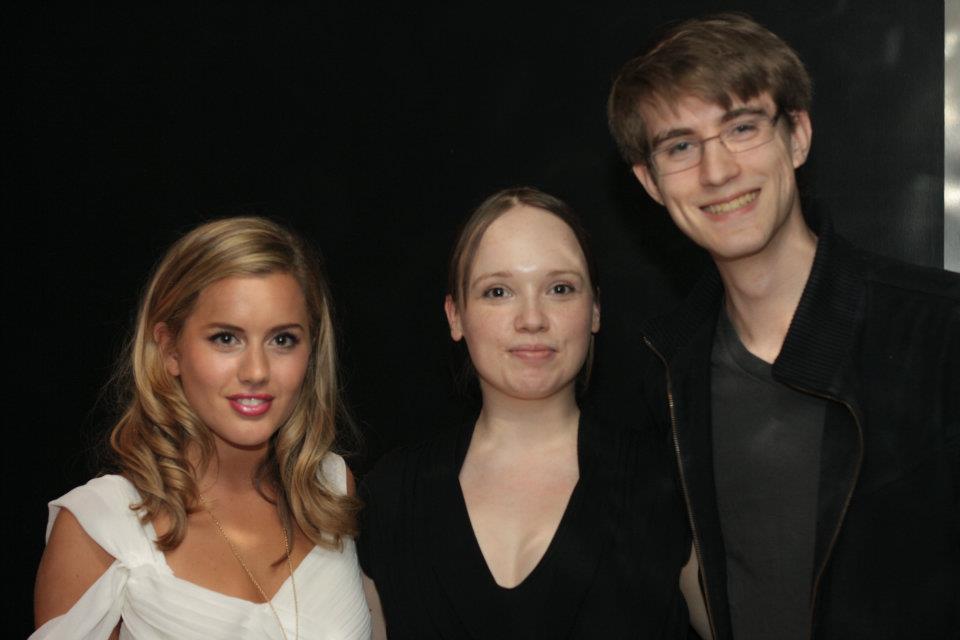
Caggie Dunlop and Catherine Balavage
Catherine Balavage: You must be very proud of the film.
Caggie Dunlop: Yeah, I am really proud of it. I actually only saw it for the first time this evening just before everyone arrived so I was a bit nervous, but I really loved it. I thought it was great. I think it is a lovely story
Quite French
Very French. Well that’s the theme and my styling is very Brigitte Bardot. I think that really lends well to it.
What is your favourite film?
True Romance.
What are you wearing? You look Stunning.
Virgos Lounge. They are an online store which is kind of vintage inspired. They do really pretty little dresses. And this is from my clothing line. [points to necklace].
You are really branching out into different areas: you have a sex column for the Evening Standard, you have the clothing line, and the acting.
And music.
Yes, that is how we first saw you wasn’t it?
Yeah, I have a lot going on, but I am not doing the Evening Standard anymore. It was very fun doing it but I am not doing it anymore.
It was very Carrie Bradshaw
Yeah, and it was great and it was fun playing that role but I really think music is where I want to go.
What would you choose between singing and acting?
Everyone asks me this. It is like saying ‘choose between your mum and your dad’, but in terms of career I don’t know, but if you said to me: ‘you could never sing again’ I would have to choose that over acting because I love singing. It just makes me happy to sing on my own. It came about quite randomly. When I sang on the show that was the first time I had ever sang in public. I have had to decide what I really want to do.
How was the acting experience?
I went to drama school and I studied acting so for me it was kind of what I wanted to do, and then when Made in Chelsea came along I got side-tracked from the acting because that was what was available to me at that point in time. The acting world is quite a tricky one. You really have to work it out. I had a great opportunity on Made in Chelsea. The acting is definitely something I want to go back to.
What does your Tattoo mean?
Sanatana Jiva. It means the never-ending and the never beginning spirit, and this [points to tattoo, specifically to the ‘J’ bit] this was for a boy who I’m not seeing anymore! [No!] It’s fine, I’m not bothered. It’s a nice tattoo.
Are you seeing anyone now?
No. I am very very spinster single
Aw, you are too young to be a spinster.
I’m happy being single.
You have so much going on with your career….
Yeah, it’s kind of like I need to focus on that at the moment and I don’t have time to focus on a relationship unless I find someone who has a complete understanding about what I am doing.
What is your clothing line called?
ISWAI. [Spells it out] I.S.W.A.I.
How did you come up with the name?
It’s an acronym for ‘It Started With an Idea’. The idea of it is about starting something new and organic with new talent, so young designers who are at school or university are designing the clothes. They get involved and hen they design an idea that I give them.
It that your motto in life?
I think so, yeah. It’s a very good one. It’s a more business thing. Though maybe not in an ethical situation.
You were the first one to leave Made in Chelsea
Yes I was
You were the biggest star and the main focus. Do you think it was a good idea to leave?
Leaving? A lot of people would argue that ‘why would you leave something when you were the central character and it was at its height of popularity and you just walk away from it with no explanation’. For me I stopped believing in what the show was about. It was a very good opportunity but I always wanted to do different things. I am very grateful for what it gave me and what I gained from it. Now I can go and become my own person.
It really has an effect on your own life and that’s not necessarily a good thing.
A lot of people are leaving now. Hugo’s leaving.
Yeah, Hugo’s leaving. I don’t know how much longer it will last but I wasn’t enjoying it and my heart wasn’t in it anymore and if something doesn’t feel right you have to go with your gut.
Would you do anymore reality TV like Spencer is doing with The Bachelor?
I would never do anything like that show. I’m not saying there is anything wrong with Spencer doing it. We are very different people, but I actually value my privacy. That could be considered a ridiculous thing to say coming from a reality TV show. I would never close any doors but it’s not in my plan. If it was something more documentary, like my music, something like that.
Who is your favourite film director and if you could work with any director who would it be?
Woody Allen or Tarantino. I think that would be a pretty crazy experience.
Did you enjoy making the film?
Yeah, I enjoyed making the film. We had to do it in a day, and it was a full on day. It was raining really badly but morale was up.
Do you have any plans to go the Hollywood Route?
I haven’t been to LA yet. So I can’t really say whether I would end up there. Watch this space. Maybe in a few years time.
Do you think doing Made in Chelsea helped you learn how to be in front of a camera?
Yes, I mean I studied method acting so it was all about being private in public. With Made in Chelsea you are having very private moments with five cameras on you. It is more staggered than people imagine. If you know anything about filming you know that you can’t create those scenes just by us walking into a bar and following us. It is all quite organised. In that sense it was helpful but then reality TV doesn’t really help in acting. It’s probably more acceptable in America.
Do you watch any reality TV like Keeping Up With The Kardashians?
I do, I love the Kardashians. I am so excited. Has the new season started now?
I think so. I saw a poster.
I do love that and I like the American ones. I don’t really like the English ones.
What do you think of Kim dating Kanye West? Are they a good couple?
I think they are. It’s nice that they were friends for ages. They are the ultimate power couple.
They are.
I’m surprised but they seem really into each other.
What’s next for you?
I am realising an EP hopefully in September. So I am developing that at the moment, which is really exciting, because for once I am in the public eye for something that I am putting out. The music is taking centre stage at the moment, but I would love to do some short films on the side and slowly developing that on the side.
Grabbing it with both hands.
Exactly, you only have one life.
What are your musical influences?
Ah, I listen to a lot of Matt Corby, who is this Australian singer who is very singer/songwriter: guitar and vocals, but also there is something quite challenging about his music, it’s really quite beautiful. I also love Jessie Ware. I have been listening to her a lot.
Do you still spend a lot of time in Chelsea?
Yeah. I was in Sloane Square today. I do spend a lot of time there, but because of what I am doing I am kind of all over. If I am gigging [ I could be in] Manchester or Shoreditch. I do love Chelsea.
Who is your favourite actor and actress?
Michael Fassbender in terms of actual ability. I think he is amazing. In terms of who I fancy: Ryan Gosling, but he is also a very good actor. He is a bit more mainstream. An actress…who was the girl who was in The Girl With The Dragon Tattoo.
Noomi Rapace
Yeah, her. I watched that for the first time the other day and I was blown away by it.
She’s brilliant.
She is fantastic. She was in Prometheus too.
No! She’s not! I was watching an interview with her and she was talking about how Ridley Scott picked her, and she said something about the Girl with the Dragon Tattoo. I was thinking ‘why has he picked this random women? ‘
She’s brilliant.
Yeah, She’s fantastic.
Are you going to do anymore writing?
Not in that nature. I would like to write a poetry book which is half poetry, half what is was like growing up. I’ve written poetry since I could write so I have volumes of poetry. Poetry is such an under-rated thing.
How do you keep fit?
I am quite bad. I go through phases of being hard-core. There is a place on the Fulham Road that I have joined called Lomax. I go there and they kick your ass, but in a good way.
What beauty products do you like.
Loving Word by Impulse, Elizabeth Arden Eight Hour Cream.
Casting call: ““Unfortunately we’re not able to offer a fee on this occasion.”
 Sadly this type of casting call is one that I’m all too used to seeing. At least 75% of castings will
contain the above sentence or a wonderfully inventive version of it (such as the incredible ‘This is
a no-pay experience!’) It’s unfortunately become a fact of acting life and I’ve become as skilled as
sifting through castings as I have at rifling through sandwiches for rogue tomatoes. Directors will try
and soften the blow by telling you that you’ll get a credit to put on your CV (gee, thanks) and that
they’ll be providing you with food on set. On-set catering can be a thing of beauty (pizza) but it can
also be an utter horror made of stale sandwiches. Apparently actors can live on credits and bread
alone. If only landlords, phone companies and councils could be fobbed off in the same way.
Unpaid work has become a rather aggressive disease in the acting world. What was once the domain
of film students and wannabe filmmakers; it has now entered the world of television. And this is
a worrying development. I understand that however much they’d like to, students and smaller
production companies can’t always afford to pay people. The ethics bother me because I believe
that if you can’t afford to pay everyone then you probably shouldn’t be making the piece in the first
place but that’s an argument for another day. Unpaid work happens and sadly, just like the damp in
our flat, I have to deal with it for now and watch it ever so slowly ruin me. I should also admit that
I’ve taken on my fair share of unpaid work in the past. Unfortunately there are times when you have
very little choice and so you can either do nothing or take on some unpaid work in the hope that
it might just get you spotted. It won’t, but you never know when that top agent is going to turn up
at a secondary school in Northampton to watch you prance about telling kids about the dangers of
heroin. But now the bigger companies have jumped on the bandwagon and suddenly everything is
starting to topple over.
There have been a string of very high-profile companies that have recently started advertising
unpaid or expenses only work. And when I say ‘high-profile’ I mean the type of companies
that produce widely watched primetime programmes that air on terrestrial channels. These
are companies that clearly have plenty of money, or at least enough cash to make sure that all
performers are fairly paid. When they start offering unpaid work, what kind of message does that
send out to all the other companies? Apparently it’s now perfectly acceptable for these businesses
(one of whom made a profit of £471m last year) to get performers to work for free. But these
companies forget that actors often have a lot of time on their hands so it doesn’t take too long
before they’re ousted via the beauties of social networking. But what happens when they get found
with their devious trousers around their tight-fisted ankles? Well, what has happened recently
is that they make like George Osborne and u-turn. However, they don’t then promise to do the
honourable thing and actually pay actors. Oh no. Their reaction is to say that they will instead be
casting friends, family or employees. That’s what this profession has been downgraded to. Actors
are now regarded so poorly that we can be instantly replaced with the make-up artist’s cousin and
the focus puller’s university mates the second we start to complain. We find ourselves so low on the
career ladder that we’ve now been downgraded to the lackey that just holds the ladder and watches
everyone else climb up it.
So what this means is that actors will yet again be forced into unpaid work as they desperately try
to keep hold of a career that’s more slippery than a greased-up seal. We continually find ourselves
being held to ransom where we can either ‘shut up and put up’ or keep fighting and risk the chance
of never working again. Just like the next actor, I’d love the exposure that a primetime programme
would offer but never at my own expense and certainly not just so an exec can save a few precious
pennies and ensure that their bonus is intact for another year. Why should they get to go on exotic
holidays when I’m left wondering how to survive for the next week on a tin of chopped tomatoes
and a rapidly ageing nectarine? It’s at its lowest, meanest level and until all actors make a stand against these companies, all we’re doing is encouraging them to turn our already fragile
industry into a laughing stock.
 The talented actor behind the blog Professionally Resting first caught my eye on Twitter. She is brave, witty and accurate about the downside of the acting industry. As an actor myself I just read her tweets/blog posts and nod. I just had to interview her for Frost, so here it is! I also have a guest post coming from her soon, so look out for that too.
What made you start your blog?
I’d been reading a few other acting blogs online and I soon realised that none really covered what it’s like to be an actual working actor. Many are written by actors who are constantly in work and that was something that I just couldn’t really identify with. Most actors I know spend a great deal of their time resting and I wanted to create something fun and supportive for those of us that regularly find ourselves within the unemployed majority. I also wanted to use it as an excuse to keep busy. There are days when there’s very little work coming in and having a blog to think about really keeps me feeling like I’m at least doing something creative.
Tell us a bit about yourself (without giving too much away)!
It’s always tough answering these questions without sounding like you’re on Blind Date! I’m in my late twenties and have been acting (on and off) since graduating from drama school in 2006. I had a break for a couple of years after getting a bit trapped in a temping job that became permanent. It was a horrible job but it meant I could have a couple of years actually earning money and being able to buy things that had previously been a luxury like food that isn’t on the reduced shelf. However, there’s nothing quite like a miserable job to remind you exactly what it is that you really want to be doing and that was the catalyst to making me find acting work again so that I could finally escape.
What do you think of the acting industry?
It’s very much a love/hate relationship. I regularly complain about it on Twitter and on my blog because it honestly drives me insane. It can feel that it often has more to do with luck than talent and you are completely at the mercy of those in control of the work that is out there. It often feels like many companies and channels operate a closed shop policy and I think many of them are guilty of working with the same very tiny gang of actors time and time again. I read an article recently that said there was a very small pool of talent out there which simply isn’t true. There’s an absolute ocean of clever and gifted people out there but they often get ignored as there are other names and faces that are deemed more popular. Unfortunately viewing figures and ticket sales are placed about creating quality work and while I accept that many of those performers that are used time and time again are very good at what they do, a bit of variety really wouldn’t go amiss!
However, having said that, there are very industries that would pay you a month’s rent to mess around as a time-travelling police officer for the day and that’s why I’m still slogging away at it!
What is the worst casting you have ever seen?
There are so many to choose from! The reason I started tweeting about castings was because people were so shocked at just how insulting and offensive and downright baffling they often were. Ones such as ‘No pay unfortunately but you will get to ride in a white stretch limo with a midget and the band’ and ‘She looks a bit like a trollop but tries to dress a bit classy’ have been incredible finds. However, I think the worst has to be one that I saw recently asking for actors to play characters in a sweatshop and the company (a very well-known TV channel) were only offering expenses. I thought I was past being shocked by castings but this one was offensive on so many levels that I genuinely had to keep re-reading it just to make sure that I was seeing it properly. Sadly I was.
What was the catalyst behind you starting your blog?
As I said, it was because I felt like I couldn’t relate to the other acting blogs out there and I felt that there needed to be a voice that represented normal working actors who often find themselves out of work. However, although I knew that it was something I wanted to do, it took me a while to actually get it started. It only happened when I was coming back on the train after a month performing at the Edinburgh Festival. I’d stupidly forgotten to bring a book and my boyfriend and I were unable to sit together so to keep myself occupied, I just started writing. After nearly 4 hours of solid writing, I realised I had a lot to say on the subject of acting and after a bit of encouragement from my boyfriend who’s also a blogger, the blog was born.
What can be done to improve the kind of roles women get?
It has to start with the writing. There is not a day goes by that I don’t see at least one casting where a woman isn’t required to either be a stripper or a prostitute and although I often make a joke of it on Twitter, it is very worrying too. There is such great writing out there for men but female roles are so often overlooked. So many times I read castings where all the male characters are given weird and wonderful characteristics while the women are just written to look nice. There are some incredible writers out there who are really trying to make sure that there are strong, interesting roles for women but they need support from the major producers for their work to get made and seen. I do think that it’s changing and television and film is starting to listen but it feels like a very slow process that needs to speed up a little!
What is your favourite, and least favourite, thing about the industry?
Let’s start with my least favourite and get the negative stuff out the way. It has to be the lack of good, paid work out there for actors. So many companies expect actors to work for free and although I completely understand how difficult it must be working on a tight budget, it’s tough when you’re faced with it day after day. Acting is something that I stupidly want to do for the rest of my life but it’s hard when people seem to think that by offering you a limp cheese sandwich and £5 to cover your travel expenses, they’re doing you a favour. I’ve done jobs in the past where I’ve essentially been paying to be part of them and that’s when you know that something has gone wrong.
And my favourite thing about the industry? It’s that you just don’t know what’s coming up next. A few months ago I was whinging on Twitter about how there didn’t seem to be any work out there and literally minutes later, my agent was on the phone with an audition for an incredible part in a feature film. I didn’t get the role but I do love how your luck changes from one minute to the next. Although it can be pretty unnerving at times, especially when you’re going through a particularly quiet spell, it’s incredibly exhilarating too. I think it’s a little bit addictive which is why actors put themselves through such torment.
You blog and tweet under a pseudonym, do you believe it would harm your acting career if you didn’t? Can you be critical?
The decision to write under a pseudonym was made so that I could be openly critical about the industry. As an actor you have to be so careful because you never know who you’re going to be working with next and I think that means a lot of actors are worried about speaking out about how infuriating this industry can be. Writing anonymously gives me the freedom to be brutally honest about the problems I face without jeopardising my acting career. Although there are days when I wish I could just tweet under my real name, I’m sure I’d have been in a fair bit of trouble for some of my comments, especially about casting calls and auditions.
What was your favourite ever job?
Despite going on about getting paid, my favourite job was one when I didn’t receive a penny. It was one of the first jobs I did after graduating from drama school and was a devised piece. It was pretty shambolic most of the time and we didn’t even get expenses but it was incredible experience seeing a project from the first meeting where we had some terrible ideas to the final night of performance. We barely sold any tickets (mainly because it was listed incorrectly meaning that most audience members turned up about 5 minutes before it was about to end) but it was great fun and real learning curve for me as a new actor.
and your least?
A summer-long Shakespeare festival. It was fun for about a fortnight but after three months away from home on only £25 a week, I was a state. The plays were performed outdoors and it was a particularly bad summer which meant that we spent a lot of time performing in soaking wet velvet dresses. British audiences are incredibly resilient and would determinedly sit there huddled up in anoraks and shelter under umbrellas while we battled with wind, rain, thunder and lightning. Because I was earning so little money, I was mainly living off value bran flakes and tomato soup so I ended the three months malnourished, exhausted, utterly sick of the sight and sound of Shakespeare and with about £4 in my bank account. That was something they really didn’t warn me about in drama school!
You can read the Professionally Resting Blog here and follow her on Twitter.

From the producer of The Bourne Trilogy…
Piper Perabo stars in COVERT AFFAIRS. SERIES 1
Out on DVD from 18 June
Also available for legal download and via video-on-demand on 18 June
Frost Magazine have one boxset of CIA thriller Covert Affairs to giveaway. For how to win, see below. The sexiest, action packed spy series to hit the UK, COVERT AFFAIRS: SERIES 1, comes to DVD on 18 June from Universal Playback. TV channel Really’s most watched drama ever stars Golden Globe (R) nominee, Piper Perabo (Cheaper By The Dozen, Coyote Ugly), Christopher Gorham (Ugly Betty, Love Bites) Peter Gallagher (The O.C., Burlesque) and is from the producer of The Bourne Trilogy, Doug Liman.
Series 2 is currently showing on Really, with Series 3 expected to air later in 2012 as the show continues to grow in popularity.
Being a federal agent isn’t easy as Annie Walker (Perabo) experiences at her first interview at the CIA. Wired up to a polygraph machine Annie has to answer probing questions from a future co-worker who clearly doesn’t think she’s up for the challenge. Using her wit and intelligence Annie manages to avoid all stages of embarrassment and impresses her new colleague with some tactful answers, all the while beaming with confidence.
Annie is thrust into the inner sanctum of the agency when she is unexpectedly promoted to field operative and is propelled into a shadowy world full of cons, killers and international crime rings when she begins working on a case lead by Arthur Campbell (Gallagher), who heads up the agencies most secretive department.
While it appears that she has been plucked from obscurity for her exceptional linguistic skills, there may be something, or someone, from her past that her CIA bosses are really after.
Covert Affairs: Series 1 is available on DVD from 18 June, courtesy of Universal Playback.
a Rafflecopter giveaway
DVD DETAILS
Title: Covert Affairs – Series 1
Certificate: 12
Run Time: xx
Genre: TV Drama
RRP (DVD): xx
Special Features:
Deleted scenes
Gag reel
Cast and crew commentaries
Behind the scenes featurettes including:
o Welcome to the farm
o Blind insight
o Set tour
 Earlier this month Channel 4 launched Foxes Live: Wild in the City, an interactive natural history event which put the power into the hands of the viewers. Anyone who owned a smart phone was a potential wildlife photographer and was able to contribute to new natural history research by taking part in the largest ever urban fox survey.
Before the survey, no-one really knew how many urban foxes lived in the UK and what the general public really thought of them. With the last study on urban foxes carried out over 30 years ago, Channel 4 is now able to share brand new wildlife research and information.
Thousands of people took part in the survey sharing their thoughts and opinions on foxes and whether they believed urban foxes lived up to their cunning reputation.
Over 11,500 people completed the survey with a massive 89% of people living in urban areas saying they liked foxes and were in favour of them living in their cities. People who weren’t so keen on foxes were those who encounter them more frequently.
Females liked foxes more than males and those aged 18 and younger preferred them to people aged 18 and above (18-50 age group). Residents in Northern Ireland were the biggest fox lovers (92% liked foxes) and foxes were least liked in London (19% disliked foxes).
On the web site there were 17,532 fox sightings logged in total in the UK. Southern England had the highest frequency of sightings. Over 75% of people in London claimed to see a fox once a week or more.
When it comes to how foxes interact with other animals, 8% of people think that foxes might regularly attack pets but only 5% of people actually reported fox attacks on pets. And foxes may be the surprise victims: people reported they were three times more likely to see foxes being chased, attacked and even killed by pets than the other way round.
Eight out of 10 people agreed that seeing foxes enriched their lives and 36% of people living in urban areas admitting to feeding foxes in their gardens. Less than 1 out of 10 people said foxes should be removed from cities.
Foxes Live: Wild in The City was backed by The RSPCA and featured experts including Dawn Scott, Head of Biology and Biomedical Sciences Division at The University of Brighton. Dawn, who also analysed the online survey results, said ‘This information will provide us with a better understanding of the national distribution of urban foxes and enable us to produce new population estimates. It has also helped us to understand people’s perceptions of both the benefits and issues of living with urban foxes.’
BRAND NEW beactive PROJECT ON A “COLLIDER” COURSE with SCI-FI SUCCESS
Multi-award-winning trans-media production company “beActive” have released another ingenious cross-platform creation, “Collider”, on Monday 4th of June 2012!
The new sci-fi concept will be available in various formats, spanning comics (print and digital), live-action web-series, app/online game, graphic novel and eventually becoming a feature film, to be released in 2013.
The first of the weekly series of eight webisodes are available exclusively on Frost Magazine first and then on beActive’s You Tube channel and stars BAFTA award-winning Scottish actor Iain Robertson of Rab C. Nesbitt and Basic Instinct fame.
The edge-of-your-seat action sees Iain’s character, Peter Ansay, a quantum physicist who is ostracised by the scientific community after issuing warnings about the dangers of The Hadron Collider.
Peter takes matters into his own hands when he breaks into CERN, the facility on the Franco-Swiss border, to sabotage the collider and accidentally transports himself and five others to 2018 where the post apocalyptic world is racked by natural disasters and at war with the “Unknown”. The six time travelers now have to fight to discover how they got there, how to survive and most importantly, how to get back to the present!
beActive’s co-founder and CEO Nuno Bernardo said: “Collider is a real sci-fi spectacular! By transporting the viewer into another dimension we are really able to delve into each of the characters pasts and follow their journey as they fight to return back to their present time.”
Follow the rise of Collider at:
www.facebook.com/colliderworld
and on Twitter; @beActiveMedia
This summer, Griff Rhys Jones is hosting a brand new comedy panel show on Channel 4, A Short History of Everything Else. This six-part series uses brilliant, hilarious and downright weird archive clips to challenge contestants to remember key moments from our recent history, and provide new and irreverent perspectives on our past. Team captains are Marcus Brigstocke and Charlie Baker.
Here, Griff talks about the ageing process, his love of box sets, and the joys of filming indoors for a change.
You said in an interview a while back that you were always too busy because you couldn’t say no to things. How’s the work-life balance shaping up these days?
Not bad, actually. The trouble is, a long time ago, I started doing all sorts of different types of programme. I think if a finger had pointed at me and said “You will be brilliant at pulling faces and doing silent, exaggerated comedy, and everyone will admire you for that,” [like former comic partner Rowan Atkinson] I would have stuck doing that. But it didn’t quite work out like that. So I put myself about a bit. I do lots of different things, and that’s rather exciting. It’s given me a new lease of life. I’m happy to do it. But I don’t say ‘no’ very easily, it’s true. In fact, I rather like having work, because it gives me the opportunity to say no to things.
What was the attraction of doing A Short History of Everything Else?
I’ve always quite fancied doing what I’d call a desk job. I’ve spent quite a lot of time on the road. And they sent me a pilot they’d made, and it just worked. There are a lot of these comedy panel games, and many of them, I have to say, are based on false premises. Often they’re too complicated – people get themselves really worked up creating a complicated structure, and the audience doesn’t have the faintest idea what’s going on, and nor does anybody playing it. This is a very simple idea – to revisit fads, moments in our past, look at them again, and answer questions and see what we can remember, about everything from the whole ‘video nasties’ scare to Boris Yeltsin and his extraordinary drunken career. We show clips, and you watch them and go ‘Wow, I’d forgotten all about that!’ And when it all comes flooding back, it really gets people talking. It’s a sort of nostalgia piece. I suppose that’s why they chose an ancient figure, old enough to have forgotten everything, to introduce it.
The programme only deals with very recent history, doesn’t it?
Yes, because we use archive footage. I don’t think we go much further back that the 70s. I’m afraid I suffer from the affliction of being nearly 60, which means I find myself going ‘The 90s? That’s not history!’ They did a recent TV series about the 70s, and I watched it going ‘Wow! All of these things were going on, with the unions and everything, I don’t remember any of that. I remember it being rather dull and wet and grey for a lot of the 70s.
What recent period of history was your favourite?
My favourite era of recent history was about 1965 to 1970, because I was growing up then. I spent my time in an awestruck state, looking at people like Jimi Hendrix, wandering around thinking there was some sort of nirvana in central London that I was denied access to, because I lived in Brentwood. So the train out of Brentwood and into town was the sort of Yellow Brick Road. We’d get into this world where people wore funny sunglasses and had frizzed out hair. That was our dream, which we fulfilled by going to the Roundhouse and things like that. After that I became an adult, and realised that you get on with life, get married, have kids, grow up, try to follow a career, do things, and the tide of history is just washing past you. Which is one of the reasons why this series is fantastic, you can watch it and go ‘Oh yes! Was that really 20 years ago?’ I went to  , and they read a piece by him and he said “as you get older, the most terrifying thing is how quickly it all goes – how it seems to all speed up.” And I do find that the last ten years have gone alarmingly quickly. I’m not ready for what it is I’m supposed to be ready for!
Are you quite pleased to be presenting a programme in a sharp suit rather than your anorak?
The sharp suits were very, very nice. Of course, I’d already been doing It’ll Be Alright on the Night, which had obviously been a huge success, because I got a nice suit out of that. I would also like to say that the red anorak that I wear in other shows is not just an anorak! It’s actually a jacket that was designed for the Italian racing drivers in the Mille Miglia in the 1950s, and it’s an object of great veneration. People write in to the manufacturers saying ‘Please, please make one for me – because Griff looks so good wearing his.’ It was made in limited edition, and I have two of them. But I must say, to be able to sit and wear a suit, and totter the journey from the dressing room to the studio is pretty good. There was a time when Mel and I were finishing off filming Smith and Jones together about 15 years ago, when being in a studio was my life. And as we finished, I thought ‘This is crazy. I’m really good at this. Changing out of a costume really quickly and getting on to the next set. I can really do that! Not many people can.’ And it’s quite nice being back in that environment. The only difference is that now I have to wear glasses to read the autocue. I did notice during filming that I look a bit like the old man from the film Up. I was really disappointed about that. That’s not my self-image at all.
Is there anything you enjoy about getting older?
Everything, absolutely everything. All that slightly furious business of peer pressure goes away. It’s fantastic. I’d really recommend it. I’m really glad that I’m still getting work. They’re probably desperate to fire me. My wife would like me to do less work – but in the last two weeks I’ve done less work, and now she wants me to work again. My wife and I were 26 when we got married. We had kids at the tremendously early age of 30. Most of my friends seem to have decided to wait until they were about 50. We go round and they’ve got toddlers everywhere, and they’ll go “Oh, oh, oh, Griff,” and hand me a child, and I’ll say “No, it’s okay, I’ve done that! I remember when you used to come round to my house and play loud music and stay up drinking til 3am while we were trying to get the kids into bed, and I don’t care about your kids!” I do a little bit of babysitting from time to time, and I have godchildren, but my kids have now fled the nest, and believe me, there’s no better time in life.”
You’re not tempted to go round to their houses and play loud music until 3am?
Luckily, that’s the other thing that happens. You suddenly think ‘Why did I ever go to stadium rock? Why did I do that? What was that about? Is there a less entertaining experience than sitting on one of those ridiculous bucket seats, peering at a sort of mini-picture of the Rolling Stones four miles away? Some of my friends still go to Glastonbury! I can’t think of anything worse. At the moment I’ve been trying to get into 40s jazz, because I’ve realised that some people are obsessed with 40s jazz, so there must be something in it. So I’m listening to a lot of that.
Back to A Short History of Everything Else – what sort of a host are you? Are you strict?
Yes, I’m quite schoolmasterly. No mucking around, please. It’s quite difficult getting them to shut up. We ran a programme which was part chatty and part quizzy – Marcus would go off on these long tangents, and Will Self, who’s a guest, was unbelievable. I’m no slouch in terms of yakking on in a non-stoppable way, but I found stopping people the most complicated thing. But I did have to be a bit schoolmasterly at times.
What’s it like being back in front of a studio audience?
Quite interesting, for me. It was quite a big transition. I was talking to Mel about this. We used to parody presenters, and then, when I started doing restoration, I had to talk to a camera. As an actor, I’d only ever looked into the camera in character, and suddenly I had to be me on camera. Now, of course, love it – I can’t go anywhere without a camera. And I now talk continually to the camera, which causes great problems for the editors, who wish I would shut up from time to time, and they could film me walking or looking at stuff. So that was quite a transition for me. And now I have to undergo another transition, being in front of a studio audience, and speaking more slowly, and getting the audience to join in.
Who are the guests you have on the show, and who would be your ideal guest?
The guests we had were all ideal guests! Robin Ince was brilliant, we had Kirstie Wark, and she was fantastic, absolutely marvellous. Not only did she have more knowledge about everything, but she was great on what I call the argy-bargy as well. Bob Mortimer was fantastic – very, very funny. And of course each guest brings a slightly different flavour. Bob was surreal, so he’d take the whole thing and push it off in a different direction. And, of course, as team captains, Charlie and Marcus were absolutely fantastic. Marcus is remarkable – his capacity to take the audience with him was really asomething – and he has such strong opinions. And Charlie was just very, very, very funny. But, to be honest, everyone was really good – it’s going to be very difficult to edit. I know it’s quite commonplace for these quiz shows to do long recordings, but we were doing three-and-a-half hour recordings, and they were pretty high energy all the way through. We’d walk off exhausted. I haven’t seen any of it, so I shall wait to see which of my gems has been cut, and then complain furiously.
Which is more difficult, being a contestant on a panel show, or being a host?
Well, they’re rather different. This has been a learning curve for me. What you’re involved with is what they call the housekeeping. If you’re a guest, there’s a lot of waiting around, and maybe a bit of preparation. But all the top guests and the top team captains don’t actually prepare anything – if you go on Have I Got News for You, Paul and Ian always tell you not to prepare stuff. They never do. They allow spontaneity to happen. One of the keys, whether you’re hosting or on the panel, is to be relaxed enough to let it happen – which is quite a challenge for me!
Does it feel like a comedy gig? Do you get heckled by the audience?
We did a lot of appeals to the studio audience. Actually, I remember Will Self heckling the studio audience, which was a bit frightening. He rounded on them and shouted “You voted for them!” I wondered whether they’d stay for the rest of the programme!
What makes you watch on TV at the moment?
I spend most of my time watching films and HBO. I’ll sit down and think ‘Oh good, they’ve made something called The Wire which goes on and on and on. And Mad Men as well. I’ll get annoyed because for some reason it takes a long time for Mad Men to come out on DVD now, which is the only way I can watch shows now. I can’t bear watching things on Sky Atlantic – it’s the principle that bothers me. You’ve paid a subscription and they’re putting in advertisements. If that’s the future of television, we’re all doomed. The future of television is being able to watch a long series one episode after another and have to say ‘Look, we cannot sit here in the middle of the afternoon and watch a fourth episode. We’ve really got to get out.’
A Short History of Everything Else is on Channel 4 on Wednesdays at 10pm from 13th June.